READERS
ThingMagic's Mercury5 Reader Is Versatile and Adaptable
ThingMagic (www.thingmagic.com) introduces its fifth-generation RFID reader, the Mercury5, achieving more 100% read rates than its predecessors on a wider variety of products. EPC Gen 2 includes a feature called Dense Reader Mode (DRM) to help solve interference problems that prevent 100% read rates; but this only addresses interference from other DRM-compliant RFID readers. Other factors in real world environments can weigh into interference problems, such as other RFID readers, legacy wireless networks, cordless phones, and even noise from fluorescent lights. Mercury5 is DRM-compliant but also has the ability to ignore these extra distractions, giving it more 100% read rates in challenging large-scale deployments.
The reader has all of the features that were available in the Mercury4 reader, including multiple protocols. It will adapt to ever-changing RFID protocols, including new variations from Gen 2 tag makers, the forthcoming ISO 1800-6C standard, and the upcoming EPC Gen 3 (expected circa 2008-9). It is a rugged reader able to withstand the physical demands of deployment environments.
Cost reductions in design and components allow for the low MSRP of $1,995, with discounts available for large volume orders. This affects the cost of the Mercury4 reader, now having the price tag of only $995.
"Mercury5 provides more 100% read rates than ever before for a wider variety of RFID tags and deployment scenarios—tags can't hide from this reader," says Kevin Ashton, Vice President of Marketing at ThingMagic. "In recent end-user comparisons, no other reader performed as well in RFID environments with a mix of tags, weak tags, and numerous interference sources. Mercury4 readers remain a great choice in more controlled and smaller enterprise environments. Fewer interference sources mean Generation 2's DRM alone is enough."
Select Reader Service 320
Prox Reader Combines Form and Function
Secura Key announces the release of the newest product in the e*Tag(TM) family of 13.56 MHz RFID readers. The ET8-WTD is designed to mount into a standard electrical box and use a Decora-style faceplate, and is available in both white and ivory. e*Tag readers work with DES-encrypted cards and key tags from Secura Key, but can also read any ISO 15693 RFID tag. The industry-standard Wiegand output makes this reader compatible with most access control systems. Visit www.securakey.com.
Select Reader Service 331
Tunnel Reader by Magellan Technology
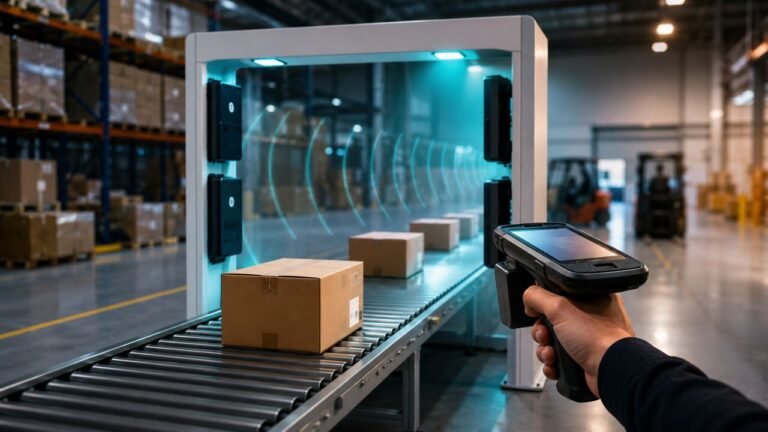
Magellan PJM(tm) (Phase Jitter Modulation) StackTag(TM) Tunnel Readers (also known as MSTRP-5050) are designed primarily to work with high-speed belt conveyors and in situations where a large quantity of RFID tagged items in all orientations need to be identified quickly and reliably. It will read and write to all PJM ItemTag(TM) and StackTag(TM) labels within the internal working volume of the tunnel regardless of the orientation of the tags or if there is zero separation between tags.
The robust reader is capable of reliably writing at a rate of 3,000 tags per minute and reading at a rate of 15,000 per minute. It operates PJM StackTag and ItemTag simultaneously. Magellan's partner, UPM Raflatac, has several PJM RFID tag offerings also. There is no interference between tunnels when placed closely together. These Raflatac products are available as paper-face tags, wet inlays, dry inlays, and in-mold tags (designed to be integrated into plastic packages in injection and blow molding processes). Both Ethernet and USB interfaces are offered for network connectivity. Visit Magellan at www.magtech.com.au and UPM Raflatac at www.upmraflatac.com.
Select Reader Service 332
Psion's Handheld Solution For Cold, Humid Conditions
Psion Teklogix Inc. (www.psionteklogix.com) announces its rugged 7530 hand-held, RFID compatible computer, claiming to be the first product of its kind to be RFID-enabled and rugged enough for the frozen storage space. It has been selected for use by the DoD.
The system incorporates Psion's RD7950 UHF Gen 2 reader (900 MHz). It is able to operate at temperatures as low as -22¡ F (-30¡ C) and withstand multiple drops on concrete from over six feet. These features (in addition to its flexibility, integration capabilities, and ergonomics) make it ideal for use in freezers, ports and container yards, and wide-area mobile computing applications that utilize RFID technology.
"We are pleased to provide our customers with RFID capabilities in one of our flagship products, the 7530," says Ron Caines, Vice President of Marketing, Psion. "The 7530 RFID compatible hand-held computer offers the best of both worlds to our cold chain customers with RFID needs."
Select Reader Service 333
HF/UHF Frequency Reader by TAGSYS
TAGSYS (www.tagsysrfid.com) announces its new dual frequency item-level reader designed for point-of-sale retail applications. It integrates HF and UHF reader modules and antennas into a single package, giving retailers the opportunity to easily reap the benefits of item-level RFID without having to deal with frequency and technology aggravations. The universal reader is 460 mm x 460 mm x 25 mm. It reads up to five tagged items at a time (HF and/or UHF), eliminating external interferences so as to only read the items being purchased.
A recent report by Venture Development Corporation (www.vdc-corp.com) indicates that spending on in-store RFID applications reached $88 million in 2005 and is expected to continue to grow. "The universal reader from TAGSYS is positioned to help accelerate the growth of item-level RFID in the retail market where a mixture of tags, HF and UHF, are rapidly becoming a reality in combating counterfeiting, black marketing, and shrinkage of goods as well as improving efficiencies in the supply chain," says Michael J. Liard, RFID Research Program Director at Venture Development Corporation.
Elie Simon, CEO of TAGSYS, adds, "With the new reader, retailers no longer need to worry about having to deploy two entirely separate infrastructures to support RFID in their supply chain and makes the frequency argument a thing of the past."
Select Reader Service 334
A New OS for Tripod Data Systems' Handheld
Tripod Data Systems(tm) (TDS) now offers additional features, improved reliability, and modern developer support and tools on its TDS Ranger(tm) rugged handheld computer with a new operating system. Windows Mobile 5.0 replaces Windows Mobile 2003 in the handheld, which improves its efficiency and reliability. Comprehensive persistent storage eliminates the need for a RAM file system or Sprite Backup. It is SDIO-enabled, so it can use compatible cards, and it also unlocks the USB host functionality of the Ranger's standard USB port.
Though not an RFID reader in and of itself, the Ranger comes with two CompactFlash slots so that devices such as RFID readers, barcode scanners, GPS, GPRS, and data storage can be added. It is rugged, meeting military standards for drops, vibration, and temperature extremes. It is also impervious to water and dust. The standard rechargeable battery can power the Ranger for approximately 20 hours under normal operating conditions.
"Field professionals have come to rely on the Ranger, not only because it keeps data safe in the roughest weather and work environments, but because it offers the latest technology and provides the features that matter most," says Bill Martin, President of TDS. "The added features and increased dependability of Windows Mobile 5.0 will help field professionals be more productive than ever before." Visit www.tdsway.com.
Select Reader Service 335
Sirit's INfinity 510 Gen 2 Reader
Sirit's INfinity 510 UHF reader is a Gen 2 compliant, multi-protocol reader built around radio and modem subsystems designed to handle high levels of interference, environmental noise, and RFID activity. It supports the Gen 2 Dense Interrogator Mode (DIM) in both FCC and ETSI regulatory environments to help with tag read/write processes in large-scale deployments. Additional features help to further optimize read rates and air interface performance.
The INfinity 510 has the market's largest application memory, allowing middleware and/or custom applications to be retrieved from the enterprise network and onto the reader for faster response times and optimum utilization of network bandwidth. Some of the functions the platform supports include advanced tag filtering, reader synchronization, triggering of conveyor gate openings, and lamp activation cues for forklift operators.
The reader comes in two models: the 510 for North American frequencies, and the 510w for North American, European, and other worldwide regulatory environments.
"This new reader represents a strong market entry that has clear performance, cost, and operational management advantages for all global enterprises," says Norbert Dawalibi, President and CEO of Sirit. "The INfinity 510 reflects the first product release resulting from the purchase of SAMSys Technologies Inc. and clearly demonstrates Sirit's ability to execute and deliver value from this acquisition." Visit www.sirit.com.
Select Reader Service 336
SkyeTek's AURA Is Next Generation of Reader Technology
SkyeTek's Advanced Universal Reader Architecture (AURA(tm)) is designed specifically as the universal reader architecture for the embedded RFID market. Customizers can expand marketing opportunities by integrating RFID as an added feature into their products with very little impact on the products' form, fit, and cost. AURA common architecture disaggregates the RFID reader into a ReaderWare software layer and ReaderDNA hardware reference designs. SkyeTek offers its AURA-based products as either a SkyeModule or ReaderWare license, which comes with access to ReaderDNA.
Examples of AURA-based products are the M0 and M9 modules. According to the company, the M0 is the world's smallest HF reader module, possessing a footprint smaller than a postage stamp. These are priced at $15 per module (for broad adoption) and $5 per ReaderWare license. The M9 is the world's smallest Gen 2/ETSI compliant UHF reader module designed for generating high ROI in applications such as handheld readers, label encoders, smart shelves, and smart carts and containers.
"While much of the recent reader development has centered on supply chain management compliance applications, the long-term opportunity for RFID readers in the embedded market is potentially greater because of the number of possible applications that can be supported," says Michael J. Liard, RFID Practice Director at Venture Development Corporation (www.vdc-corp.com). "The SkyeTek architecture allows companies to embed readers in product lines, en masse, to create new, RFID-enabled applications. When paired with a cost-efficient business model, this top-line benefit results in high returns on investment and lower total cost of ownership for customers." Visit www.skyetek.com.
Select Reader Service 337
RFID Reader for Europe by Symbol
Symbol Technologies' XR480 is an industrial-class RFID reader that supports European RFID standards and is already in use by some early adopters. It can provide support for up to eight read points to help decrease deployment complexity and increase flexibility. It delivers Gen 2 Dense Reader Mode (DRM) operation, which enables the flexibility to support the European standard as it evolves.
Using Microsoft's Windows CE operating system, it can integrate and interact with existing IT infrastructure while reducing the support costs associated with multi-platform environments. The platform is backward compatible with Symbol's XR400 reader (whose architecture it was built on) and leverages existing XR400 capabilities, including application hosting. The XR480 also provides Control I/O and USB interfaces to manage devices ranging from motion sensors and light to memory sticks and display screens.
"The XR480 European RFID Reader builds upon Symbol's diverse customer and application experience with large-scale RFID implementations," says Anthony Bartolo, Vice President and General Manager, RFID Division. "By allowing customers to manage and move information instantly upon data capture, the XR480 truly extends business intelligence to the edge of the enterprise."
Select Reader Service 338
|