ASK THE EXPERT
Item-Level Tagging: When Will It Happen and What Are the Obstacles to Overcome?
By Robert Locke, Contributing Editor

"The cost of tags is not an issue when you're tagging high-value, fast-moving, high-shrinkage items."
One of the biggest challenges in supply chain management and in retail operations is to know exactly what is in stock and precisely where each item is. As CEO of Vue Technology, Robert Locke has an ideal vantage point to see where the industry is headed with item-level tagging, and how the industry might get there.
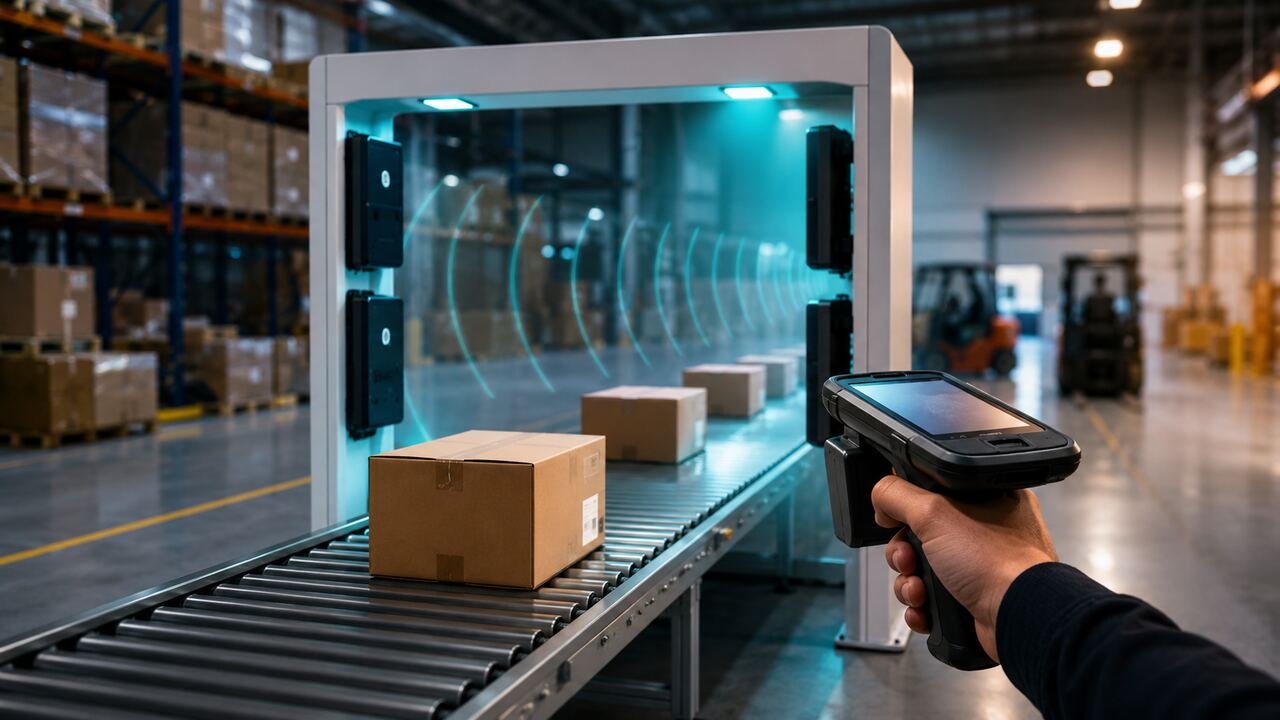
Vue's technology is capable of linking hundreds of antennas to one reader, which eliminates the costly and cumbersome process of networking countless readers and antennas to deploy item-level RFID solutions. By drastically reducing infrastructure costs while increasing scalability and reliability, this technology can provide unprecedented inventory visibility while delivering the item-level solution at a reasonable cost.
Q: What is your projected timeline for large-scale deployment of item-level tagging?
A: At Vue, we've already completed several successful item-level tagging pilots with retail customers who are seeing substantial returns. Vue's technology has effectively removed the chief impediments to stationary item-level visibility applications running in retail and warehouse environments. Based on successes we've seen and other projects that are currently underway, we are confident that you'll begin seeing significant item-level tagging deployments in 2006 and multiple chain-wide rollouts in 2007.
What are some of the impediments to implementing item-level tagging?
When you consider how quickly RFID is evolving and the documented cases of successful item-level tagging pilots, we feel that many of the historical impediments, including technology barriers and market-driven concerns such as tag cost are quickly diminishing.
For example, today at Vue we've circumvented what has been one of the most significant technological barriers to large-scale deployments—the number of readers required to deploy large numbers of antennas. The large number of readers required to do in-store item-level applications results in massive reader-to-reader interference and significant reader management problems. These problems have already caused the failure of several large warehouse pilots where the number of readers was only in the range of 20 to 50. Meanwhile, Vue has executed successful pilots with nearly 1,000 antennas working in close proximity in a real environment.
The cost of tags and where in the supply chain items will be tagged are the major issues we face today in item-level tagging. The cost of tags is not an issue when you're tagging high-value, fast-moving, high-shrinkage items. A 12-cent tag becomes insignificant in this environment when compared to the benefits of having inventory accuracy levels of over 99% combined with the knowledge of exactly where each item is at any given time. Choosing the right products with the right supply chain characteristics is the key to a successful implementation.
What are the ROI opportunities with item-level tagging?
We've done quite a bit of research in this area, and have found that item-level tagging can lead to a very compelling ROI. We saw reduction in out-of-stocks of 50% in our Tesco pilots. This has a dramatic impact on sales when you're talking about fast-moving items where time in hours is important. In some cases, DVDs can see up to 50% of their lifetime sales in the first five or six days of release. We have also found that item-level RFID can reduce employee theft by up to 50%. Labor required for restocking, receiving, and returns has been reduced by up to 70% in our pilots. Beyond these immediate benefits, we can foresee opportunities in which organizations can streamline their business processes and apply deeper levels of business intelligence to improve their operations with accurate item-level data.
Most of the retailers with whom we have worked believe that the out-of-stock and replenishment applications emphasized in pilots are really just the vehicle with which to test the technology and build conservative ROI models. The real value comes in adding relatively inexpensive extension applications, enabled by the core item-level infrastructure, which give advanced item-location power directly to store customers and staff, even for misplaced items. Item-level RFID infrastructure also makes it possible for retailers to completely reengineer their replenishment approach, since vendors can now see what is in the store and on the shelves without making a costly visit to the store. Most retailers believe that item-level RFID will lead to much greater utilization of vendor-managed inventory.
Are there other benefits to item-level tagging that don't show up in an ROI calculation?
Retailers are very focused on customer service. Because each item has a unique serial number, retailers can also have detailed information on the size, style, color, version, history, or anything else that they choose to track. The ability to leverage this information to improve the customer experience is extraordinary. With items like shoes, jeans, or bras, where one style can have 30 to 40 size permutations, a store associate with a handheld device can access this information without leaving the customer's side.
What financial challenges does item-level tagging face?
RFID equipment costs can be prohibitive when it comes to item-level tagging. While antennas are relatively inexpensive, readers can cost $2,000. The problem with most applications is that costs associated with the number of readers required can destroy the ROI. That's where Vue's item-level solution can make the difference. Our solution can network a thousand antennas to a single reader, dramatically reducing costs and making the ROI compelling.
What concerns regarding privacy issues arise with item-level tagging and how you do feel about them?
Issues of privacy around item-level RFID tagging should be taken seriously. The issue of privacy deserves a forum, but I don't think that forum is at the technology level. We see that issue as one between retailers and consumers. Each retailer needs to develop a policy that makes sense for them and their customers.
Describe the issues (technical, financial, political) surrounding item-level tagging in regards to EPCglobal standardization?
With respect to item-level tagging, the issues facing EPCglobal and its member companies include frequency, tag form factor standardization, and the use of user defined memory. There is still a great deal of disagreement on the basic facts and physical principles of the two major choices of frequency—UHF and 13.56MHz. Due to a number of factors including price, wavelength size, and reaction to different materials like liquids; it is likely that both technologies will be used at the item-level. Within a given vertical market or single product category, one technology will likely prevail.
The organization and use of user memory, which is the extra tag memory that is often available beyond the bits used for the EPC number, is another issue which will be worked out as tag manufacturers consolidate the requirements of their customers. At the moment, it is only a discussion item that may or may not rise to the level of an EPCglobal standard.
Tag form factors need to be standardized in order to create economies of scale, simplify tag type specification, and continue to drive tag prices down. This is an important issue when a retailer will ultimately have tens of thousands of suppliers involved in selecting and applying tags to products. Some work has been going on at EPCglobal to create classes of tags and, it is hoped, find a minimal set of tags which cover the broad range of item-level tagging applications.
Can you list any examples of successful case studies regarding item-level tagging?
Gap did an item-level pilot in 2001 in which they achieved a 99% inventory accuracy rate. Prada did an item-level pilot in their Soho store in 2002. The METRO Group has an item-level pilot running in their store of the future in Rheinberg, North-Rhine Westphalia, Germany. Marks & Spencer did an item-level trial on men's suits in nine stores in 2004, and they are rolling out more stores this year. We concluded a two-store pilot at Tesco this year, and we also recently completed an item-level pilot at Best Buy, among other confidential pilots.
All of the item-level pilots that I am aware of have demonstrated that there are enormous benefits associated with item-level tagging. The interest in our technology is not driven by mandates. It is driven by the opportunity to serve customers better, reduce costs and drive revenues cost effectively. We're excited about the opportunity to play a leadership role in bringing these benefits to our customers.
Robert Locke, CEO of Vue Technology, joined Vue in February of 2004 because he saw the opportunity to participate in revolutionizing how manufacturers and retailers deploy and utilize item-level RFID solutions. He brings over 20 years of experience leading successful companies, both established and entrepreneurial, in retail and RFID markets.
|